A Hobbit Journey by Matthew Dickerson
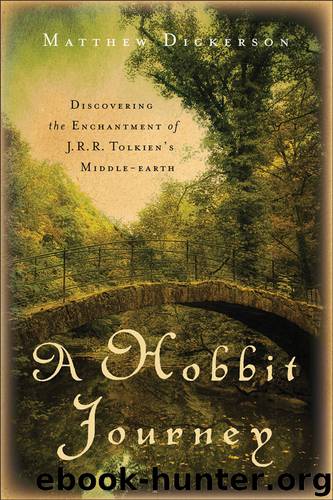
Author:Matthew Dickerson
Language: eng
Format: epub, mobi
Tags: REL013000, REL062000, J. R. R. Tolkien (John Ronald Reuel) (1892–1973), Lord of the rings, Epic literature (English—History and criticism), Fantasy fiction, English—History and criticism, Free will and determinism in literature, Middle Earth (Imaginary place), Battles in literature, Courage in literature, Ethics in literature
ISBN: 9781441240323
Publisher: Baker Publishing Group
Moral Responsibility
Now we can begin to see even more deeply the significance of the gift of free will. One’s choices mean more than which of two (or ten, or twenty) flavors of ice cream he or she will consume. There is good, and there is ill, and as Aragorn says, “It is a man’s part to discern them, as much in the Golden Wood as in his own house.” That there are objective moral standards by which our choices may be judged is also to say that there are real—that is, moral—consequences to our actions, and where we have free will and moral consequences, we have moral responsibility. Aragorn and Éomer are free, and they must make choices; and because there is an objective definition of good and ill, Aragorn says, they have a moral responsibility—a “man’s part”—to discover what that “good” is and to act accordingly.
Once again, though Tolkien gives these ideas a fuller expression in The Lord of the Rings, and a mythological (or theological) basis in The Silmarillion, we can see the notion of moral responsibility even in The Hobbit. For example, The Hobbit is full of references to duty, a word that refers to an obligation or responsibility of a moral or legal type. Time and again, we see Bilbo making moral choices about what he ought to do, usually in contrast to what he wants to do: “He had a horrible thought that the cakes might run short, and then he—as the host: he knew his duty and stuck to it however painful—he might have to go without” (Hobbit, 38). Like many instances early in The Hobbit, the consequences of Bilbo’s choice are not presented as especially significant at the moment; the issue at stake is only whether or not Bilbo or the dwarves will get the last of the hobbit’s supply of cakes. Yet in basing even such small decisions on moral responsibility, Bilbo is training himself, so that when the more significant decisions are placed before him—whether or not he ought to risk going back into the goblins’ caves to rescue the dwarves, for example—he is ready to perform his duty. This is exactly what we see: “He had just made up his mind that it was his duty, that he must turn back—and very miserable he felt about it—when he heard voices” (Hobbit, 137). Though these two choices involve consequences of entirely different magnitudes, Tolkien uses a similar voice in presenting them to the reader. In both cases, the contrast is between doing what is comfortable and doing what is right, and Tolkien interrupts the sentence to let the reader know that the right thing is a “painful” or “miserable” choice. We also must note that in both cases there is no legal obligation on Bilbo to act in some particular way; in other words, the obligation implied by duty is a moral one.
Because of this connection between duty and moral obligation, the notion of duty and Tolkien’s use of the concept is interesting.
Download
This site does not store any files on its server. We only index and link to content provided by other sites. Please contact the content providers to delete copyright contents if any and email us, we'll remove relevant links or contents immediately.
4 3 2 1: A Novel by Paul Auster(12392)
The handmaid's tale by Margaret Atwood(7763)
Giovanni's Room by James Baldwin(7346)
Asking the Right Questions: A Guide to Critical Thinking by M. Neil Browne & Stuart M. Keeley(5775)
Big Magic: Creative Living Beyond Fear by Elizabeth Gilbert(5771)
Ego Is the Enemy by Ryan Holiday(5448)
The Body: A Guide for Occupants by Bill Bryson(5096)
On Writing A Memoir of the Craft by Stephen King(4944)
Ken Follett - World without end by Ken Follett(4731)
Adulting by Kelly Williams Brown(4574)
Bluets by Maggie Nelson(4556)
Eat That Frog! by Brian Tracy(4540)
Guilty Pleasures by Laurell K Hamilton(4449)
The Poetry of Pablo Neruda by Pablo Neruda(4107)
Alive: The Story of the Andes Survivors by Piers Paul Read(4032)
White Noise - A Novel by Don DeLillo(4009)
Fingerprints of the Gods by Graham Hancock(4004)
The Book of Joy by Dalai Lama(3986)
The Bookshop by Penelope Fitzgerald(3853)
